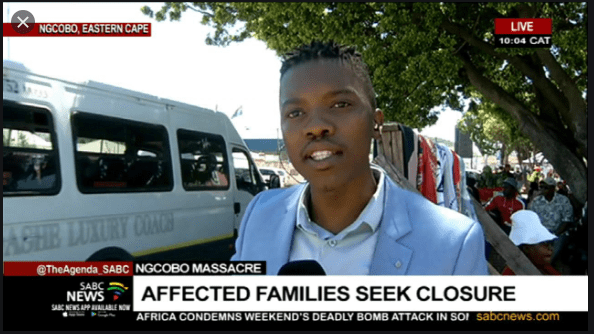
In an interview with Athule Joka who a journalist of the SABC as he shares his perspective on gender equality as a young journalist working in a newsroom. Joka was working with the Daily Dispatch before joining the South African Broadcasting Channel in the year 2018.
Questions
Q: How would you describe being a journalist in the new age of digitization?
A: I would say it is quite challenging and demands one to constantly alert of developing trends.
Gone are the day where a journalist will go to work and work the whole day to file a story later. Nowadays most people access news through digital platforms. Therefore, to avoid being scooped journalists are required to act swiftly to deliver content. For example, a normal day on the field could involve writing cue sheets for the anchor who will cross to you live. You are required to narrate what is happening live. Moreover, you will need to update social media pages on what is happening. As you correctly pointed out that news media houses are cutting down on staff therefore, journalists nowadays are expected to be all-rounders. From operating the camera, writing, reporting, editing, and feeding the news which is basically what I do on a normal day basis. It is demanding and takes its toll and most journalists today will have it difficult to have a balance between work and a social life.
Q: Do you feel there is a difference between journalists based on their sex and what motivates your response?
A: In all honesty I have not picked up any difference on journalists and their sexuality. In fact, currently I see most females in the company SABC, I work for moving up the ladder.
Q: The Gender links research show huge inequality between men and women at middle management level, as a senior news reader, what is your experience?
A: Like I said maybe in different companies it could be true but no in my experience. I have worked at the Daily Dispatch and SABC and I have seen equality in all the structures.
Ferial Haffajee was the first female editor of the Mail&Guardian publication in the South African history in the year 2004 and this is according to Dr Glenda Daniels in the 2018 State of the Newsroom report.
Gender Equality as a basic human right is important in our societies to achieve peace and sustainable developments. Empowerment of women has shown to yield productive results. Gender equality in the media is important not only to secure women’s right to freedom of expression but also to promote diversity and plurality in the media, which are essential if the media are to play their appointed role in democracy.
Q: From your point of view as a journalist, how is the representation of females in the journalism and media sphere today, particularly in the media house that you are working for? Do you feel like there is at least anything close to equivalence between men and women?
A: In my experience and in the SABC generally there is a lot of bright females working as journalists. They are contributing immensely to the world of journalism. In our SABC office in the Eastern Cape there are eight female reporters and four are permanent. It was seven of them, but three females have left the company recently to take positions elsewhere.
Q: Many media houses have been alleged to be closing, ones such as Associated Media Publishing together with around 43 radio stations. do you perhaps have any idea how this is going to impact gender equality in the newsrooms?
A: My view is that this would affect every journalist based on skill and not based on their sexuality.
Q: What issues do you guys consider when gender equality is concerned?
A: According to the policies of the company I work for it needs comply with equity. There are policies that speak to affirmative action which looks to address inequalities of the past. Females were not empowered in the past therefore there is a dire need for redress which the company is currently undertaking.
Q: Do you feel like the government of South Africa should do something about or for journalists who lose their jobs due to retrenchments and journalists being left wanting without jobs or income?
A: I strongly agree, the profession of journalism is a cornerstone of democracy. It is through media in which we can guard whether we are practicing freedom or not. Therefore, the grave situation of journalist losing their jobs and not being able to make an income needs to be fixed. Journalists are the vanguard of society and are the one who hold the government accountable.
Q: The Beijing Declaration and Platform for Action has been pushing for the advancement of female journalists in the media since about 23 years ago. Do you feel like there has been any progress with either one of the two strategies they came up with to ensure this advancement?
A: I would say there has been an advancement of women in the media sector. Such initiatives should continue to fight for equality in all spheres.
Q: Gender roles is a big factor when it comes to gender equality. Does gender equality mean identical roles for both men and women in the society?
A: In the past camerawork was mainly done by males. I have seen several young females coming in and doing that nowadays. I would say the thin line in gender roles is being reduced and people are doing same roles.
Water your plants while waiting for rain…
unknown
 Victor Phemba